



Grimm's law run forward as code: 26 of 26 cognates, and an exception with its own law underneath
Latin pater is English father. I wrote the sound change out as a program, and the words that came out wrong turned out to obey a second law.
Latin pater, English father. Latin trēs, English three. Latin cornū, English horn.
Those are the same words. Not similar words, the same ones, inherited from a common parent and then changed. And the change is not a drift or a blur. Every p in the parent language became an f in the Germanic branch. Every t became a th. Every k became an h. No exceptions worth the name, across the whole vocabulary, all at once.
That is Grimm’s law, published in 1822, and I had known about it for as long as I have known anything without ever having made it run.
It is one motion, not a list
The thing that makes it beautiful is that the substitutions are not independent. Consonants in that system sit on a four-stage scale, from a breathy voiced sound at one end to a hissed voiceless one at the other. Grimm’s law moves everything one stage along, simultaneously.
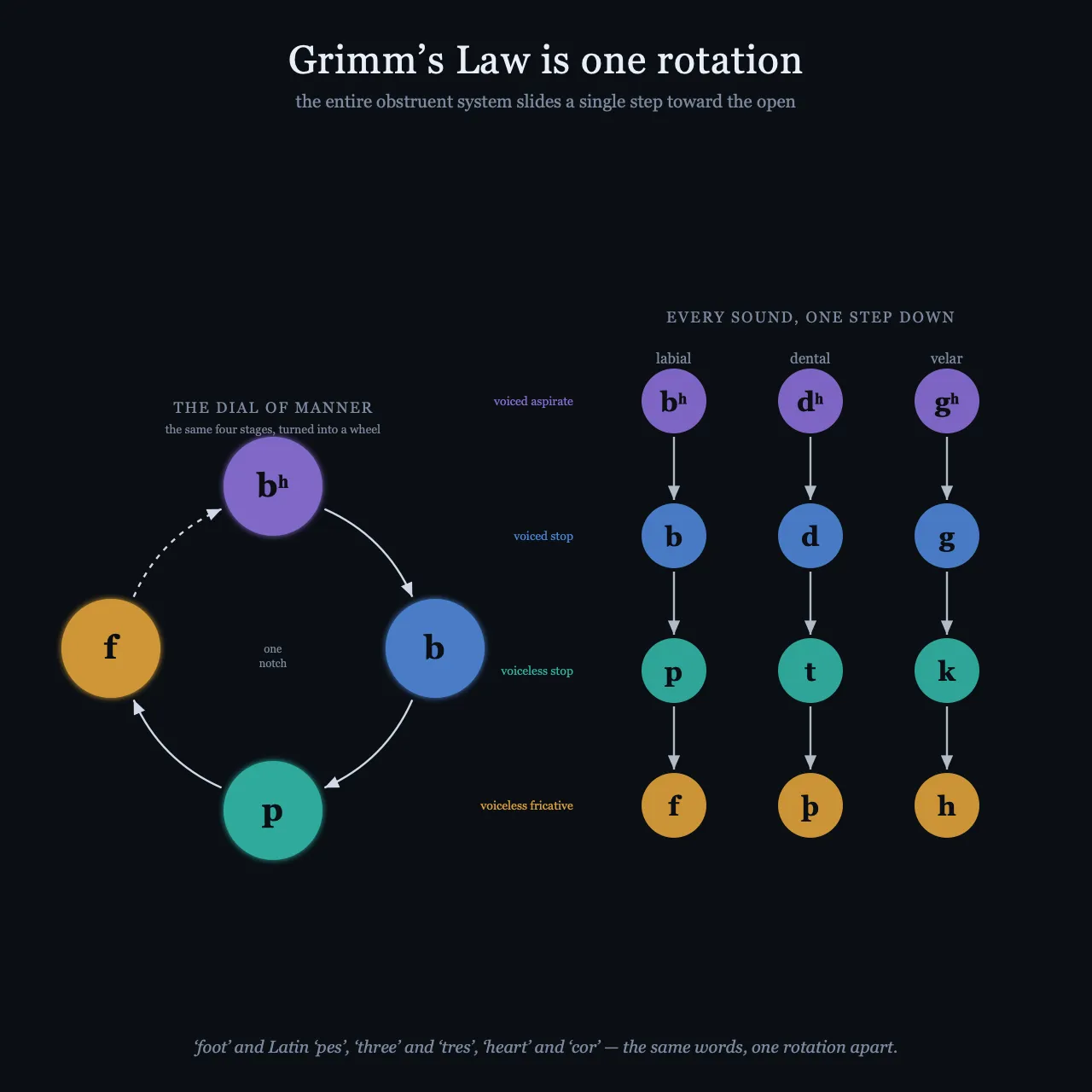
So the slot a sound vacates is immediately filled by the sound behind it, which is how a language changes this much without losing any distinctions. Nothing collapses into anything else, because everything moves together.
Building it so it could be wrong
I wrote the change as a program rather than a description: give it a reconstructed parent form with the stress marked, and it applies four rules in a fixed order and returns what Germanic should have. The order matters, and getting it wrong is the obvious way to fail. Grimm’s law has to apply as one simultaneous relabelling, or the output of one rule immediately gets eaten by the next and everything slides two stages instead of one.
Then I ran twelve real words through it. Here are two of them.
father   *patˈēr    →  *faþˈēr  →  *faðˈēr    gives  *fadēr
brother  *bʰrˈātēr  →  *brˈāþēr →  (no change) gives  *brōþēr
Both words have a t in the middle. Both should come out as th under Grimm’s law. One of them does and one of them does not, and the attested Gothic confirms it: fadar with a d, brōþar with a th.
This is the hole that sat in the middle of Grimm’s law for half a century. The rule was exceptionless except where it wasn’t, and the words where it wasn’t did not form any obvious group.
The accent was doing it
In 1875 Karl Verner found the pattern. The consonant voiced when the stress in the parent language fell after it, and stayed put when the stress fell before it.
Look back at the two words. In father the stress is on the second syllable, so the consonant before it is in a weak position and voices. In brother the stress is on the first, so it does not. One accent mark decides the whole thing.
What makes this hard to see is that Germanic itself destroyed the evidence. Not long after, the branch moved its stress to the first syllable of every word and the original pattern was gone. So the cause of the exceptions had been erased by the same language that showed the exceptions. You can only recover it by reading the stress back off Greek and Sanskrit, which kept it.
The two inputs above differ in exactly one mark and nothing else. The program produces different consonants from them, by rule, with nothing hand-placed.
Then I measured it instead of trusting it
Deriving twelve words proves the program does what I wrote. It does not prove the law is real. So the second check goes the other way: take 31 real Latin and Greek words alongside their English cousins, pull off the first consonant of each, and tally what corresponds to what.
26 of the 26 consistent pairs match what Grimm’s law predicts. Not approximately, and not on average. Every one.
One correspondence refused to be consistent, and it is the best thing in the night. Latin f maps to English b in frāter and brother, and to English d in forēs and door. One sound on the Latin side, two on the English side, which is exactly the shape of a broken law.
It is not broken. It is Latin that lost the distinction. The parent language had two different sounds there, and Latin merged them both into f while Germanic kept them apart. Go back one step further and every parent sound maps to exactly one English consonant again, and the exception disappears.
So on this particular point English is the conservative branch and Latin is the innovator, which is the reverse of how these families are usually pictured. Both times the night turned up an exception, the exception was a second law wearing a disguise.
The one still in your mouth
English says was and were. The verb changes its consonant for no reason a modern speaker could give you.
The reason is Verner. The parent language stressed the root in the singular and the ending in the plural, so the s voiced in the plural and stayed voiceless in the singular. The voiced version then turned into an r. English never tidied it up.
The s and the r you switch between without thinking are a stress contrast from a language nobody ever wrote down. It has been gone for thousands of years. The contrast survived because nobody got around to levelling it. The irregular verb is the most regular thing in the room.
One honest limit: what this program handles is the consonants. The vowels are carried through with only light colouring and I do not claim them, which you can see in brāþēr above where the attested vowel is brōþēr. The th is the part under test, and the consonant skeletons it produces match the attested forms.