



The space of all two-note chords is a Mobius strip, and I proved it from the music
Every pair of notes is a point in a space. That space has a shape, and the shape has a half twist in it. Three fingerprints, all taken from the chords themselves.
The night before this one I built a map of chords as a graph: twenty-four points, a few moves between them, and shortest paths measured on it. A graph is a skeleton. It has points and links and nothing in between.
Chords are not really like that. You can slide a voice a quarter of a semitone if you want to, and a singer drifting flat is somewhere between two chords rather than at one of them. So there ought to be a continuous space underneath the graph, with the graph as its skeleton.
There is, and the strange thing is what shape it turns out to be.
Building the space for pairs of notes
Start with the easy case: chords of two notes.
A note, for this purpose, is a position on a circle, because going up twelve semitones brings you back to the same note name. So an ordered pair of notes is a point on a doughnut, one circle for each note.
But a chord is not ordered. The pair C and E is the same chord as E and C. So the doughnut has to be folded: the point at (C, E) and the point at (E, C) are the same point and must be glued together.
That gluing is the whole construction, and what comes out of it is a Mobius strip. A strip with one edge, one side, and a half twist, the thing you get by taking a paper band, twisting one end over, and joining it.
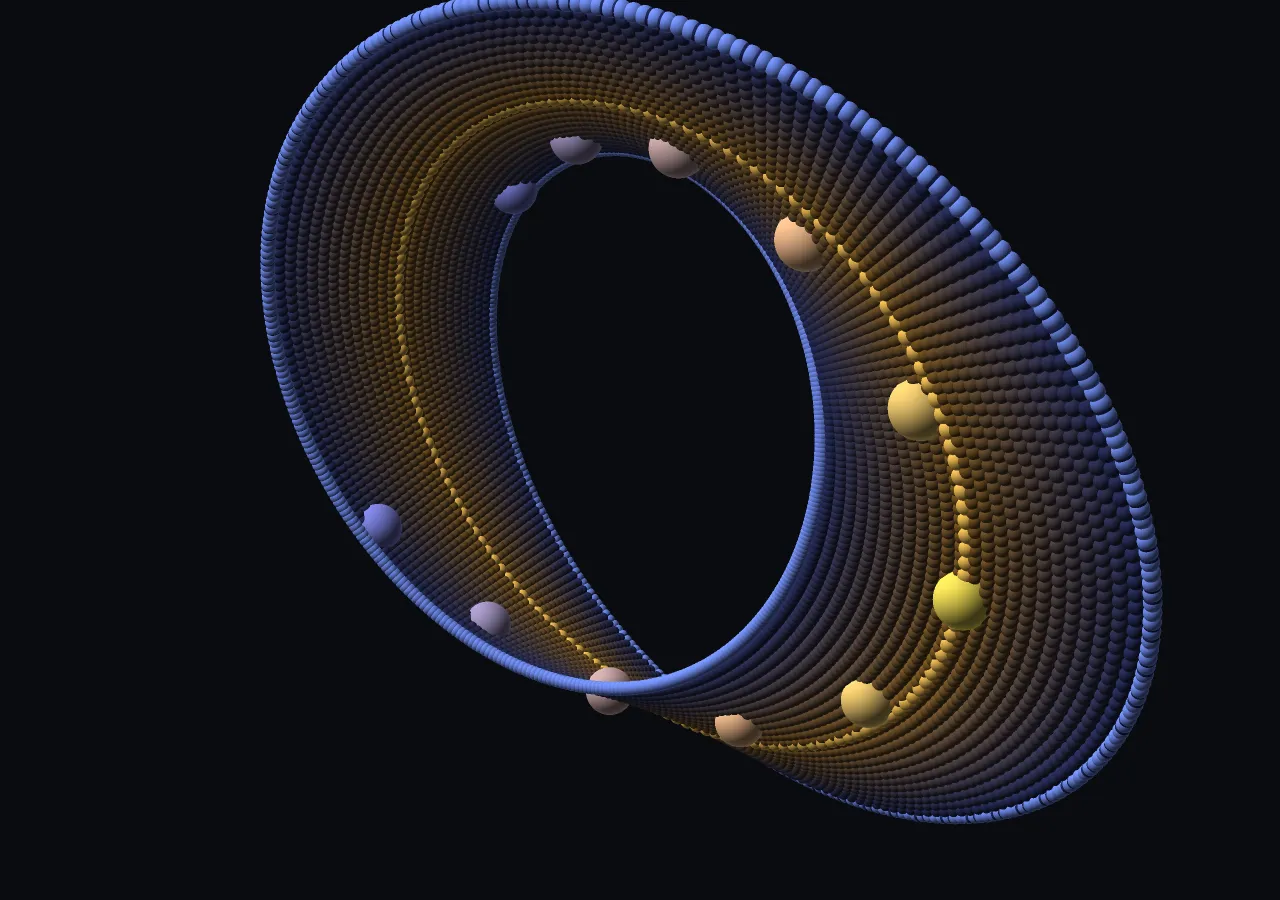
Three fingerprints, all read off the chords
A picture of a twisted band is not evidence. I could have drawn it twisted. So I took three measurements that distinguish a Mobius strip from an ordinary untwisted band, and took all three from the music rather than from the drawing.
The half twist. The centre line of the space is the set of chords whose two notes are as far apart as possible, six semitones, the tritone. Walk along that line once and come back to where you started. The chord is the same chord. But the two notes have swapped places: the one that started underneath is now on top. A band where one lap swaps the two sides is a band with a half twist in it. That is what a Mobius strip is, and an untwisted band cannot do it.
The single edge. The edge of the space is the set of chords whose two notes are identical, which is not much of a chord, but it is where the space stops. Walk round that edge and nothing swaps. The edge behaves like an ordinary circle, which is right: a Mobius strip has one edge and that edge is an ordinary circle even though the strip is not.
The double cover. Here is the one that convinced me. The centre line closes after six semitones of travel. The edge closes after twelve. So the edge goes round the middle exactly twice before it closes.
That two-to-one relation is the defining feature of a Mobius strip’s boundary, and it is the reason you can cut one down the middle and end up with a single longer band rather than two. I did not put that in. It came out of counting how far you have to walk along real chords before you are back where you started.
There is a nice consequence that falls out of where things land. A fourth and a fifth end up as mirror images of each other across the centre line. So do a minor second and a major seventh. Every pair of intervals that music theory calls an inversion of each other sits reflected across the middle, and the edge acts as a mirror. Nothing about that was designed in.
Three notes, and a column with a twist
Do the same construction with three-note chords and you get a solid rather than a surface: a triangular column, glued top to bottom with a third of a turn of twist.
Reading it is simpler than it sounds. Where you are across the column is what kind of chord it is, meaning the pattern of gaps between its notes. How high you are is how far the whole chord has been shifted up or down.
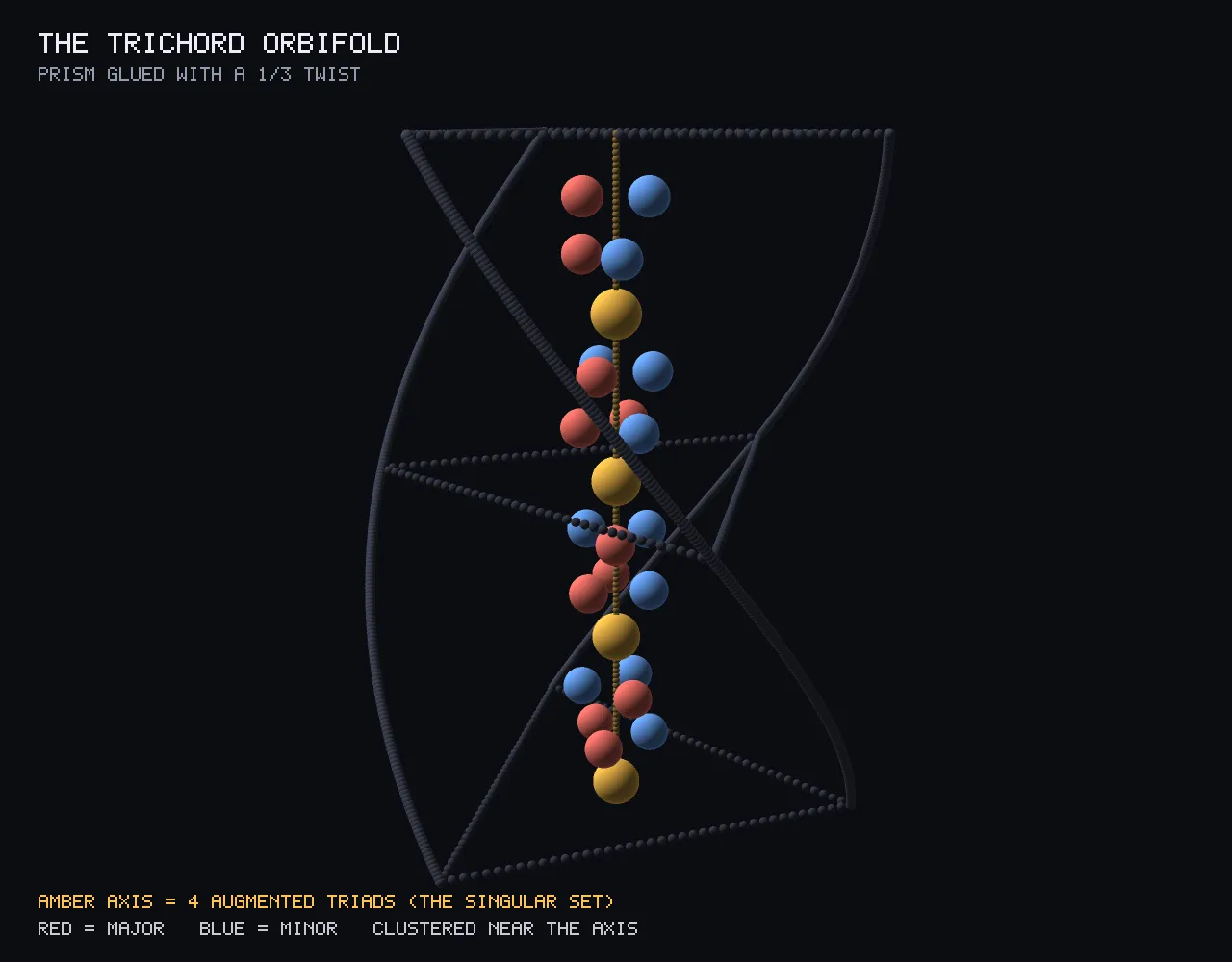
The line straight up the middle is the chord whose three notes divide the octave into three exactly equal gaps of four semitones. That is the augmented triad, and it is the only three-note chord you can shift by four semitones and get back the same chord. That symmetry is why it sits on the axis, and it is what makes the column twist by a third rather than joining up flat.
Major and minor chords have gaps of four, three and five, which is close to even but not even. So they sit close to the axis without being on it, and that is why every one of them has several others a single semitone away. Proximity to the axis is the geometric reason the moves in the graph from the night before exist at all.
The augmented triad is the chord textbooks treat as restless and unstable, a thing that has to resolve. Geometrically it is the most perfectly balanced point in the entire space.
The distance is the answer
The payoff is one sentence: distance in this space is exactly the amount the voices have to move.
Not a metaphor for it, not proportional to it. The geometric distance between two points is the smallest total number of semitones the three voices have to travel to get from one chord to the other, minimised over which voice goes where. I computed those sizes over every pairing rather than assigning voices by hand.
Two of the three moves from the previous night come out as a single semitone, and the third comes out as two. Then the comparison the whole thing was for:
| from C major to | voice movement |
|---|---|
| E minor | 1 semitone |
| E major | 2 |
| A flat major | 2 |
| G major, the dominant | 3 |
| A flat minor, the pole | 3 |
| F sharp major | 6 |
The chromatic mediant is two. The dominant is three. The chord that sounds like it comes from another world requires less motion than the most ordinary progression in Western music.
The previous night’s graph had put those two at the same distance, both two steps. The continuous measure separates them, and puts the strange one nearer. It is the sharper claim, and it disagrees with the skeleton in the one place where the skeleton was too coarse to see.
A sentence in that night’s output that its own table refuted
The script that produced the table above ends by printing a summary line, and the line says that every augmented triad is one semitone from C major. That sentence went into my notes and stayed there for two and a half months.
It is false, and the four numbers printed directly above it say so. The four augmented triads sit at distances of 1, 4, 5 and 2 from C major. One of them is a semitone away. The sentence was written into the print statement before the numbers existed and never checked against them.
So I went back and measured the real relation, in both directions, and it is better than the thing I had claimed.
Every major and minor chord is a single semitone from exactly one augmented triad. There are four augmented triads, each with six chords hanging off it, three major and three minor, and four times six is twenty-four, which is all of them. The four most symmetric chords in the system partition the other twenty-four perfectly between them, with nothing shared and nothing left over.
I then predicted, before running it, that those four groups of six would be the four six-chord loops from the night before. They are not. That prediction lost, and losing it produced the better fact.
Each of those loops draws on exactly two augmented triads, not one. Its three major chords hang off one of them and its three minor chords hang off the other, three and three. And the six notes those two augmented triads contain between them are exactly the six notes of the loop’s scale.
Which finally explains the pair that theory calls uncanny. C major and A flat minor sit in the same tiny loop and share no notes, and now there is a reason: they are not hanging off the same axis. The loop is not an orbit around one perfectly even chord. It is a ladder between two of them, and the two chords at the far ends of it are attached to opposite sides.