



Quantum tunneling: 6.3% of a particle crosses a wall it cannot climb
A wave packet with half the energy it needs still comes out the far side. I built the solver, proved it on a case with a known answer, then measured the leak.
A ball rolled at a hill either gets over it or it does not. The rule is arithmetic: if the ball does not carry enough energy to reach the top, it comes back down the side it came up. There is no third outcome.
Particles do not obey that. Send one at a barrier it does not have the energy to climb, and some fraction of it comes out the far side anyway. This is not a rare laboratory curiosity. It is how the sun burns, how a flash drive holds a bit, and how a scanning tunneling microscope sees single atoms.
I had never built a quantum solver. So the night was to write one from nothing, in natural units, and measure the leak myself.
Proving the solver before trusting it
The thing I care about is a number in the range of a few percent. A solver with a small systematic error would hand me a plausible wrong answer and never complain, so the solver gets proved first, on cases whose answers are known in advance.
Three checks, and all three had to pass before any physics rode on it.
Probability has to stay at exactly one. The method I used steps the wave forward by splitting each step into a position part and a momentum part, and it is supposed to conserve total probability exactly. Over a full run it drifted by 2 parts in a trillion, which is the arithmetic of the machine and not the physics.
A free packet has to spread at the known rate. Released with nothing in its way, a Gaussian packet widens along a formula with a closed form. Mine matched that formula to 14 decimal places.
And the general machinery has to reproduce the special case. I wrote a second, completely different engine that computes transmission for any sequence of flat barriers by multiplying matrices. For the one barrier where a textbook formula exists, the two agreed to 9 parts in a quadrillion, which is as close as double precision gets.
Only then did I point it at a wall.
The measurement
The barrier is twice as tall as the particle’s energy. Classically that is a closed door, and the transmitted fraction is zero with no rounding involved.
The packet arrives, and the picture in the middle of the collision is the part worth watching. The incoming wave and the reflected wave overlap in front of the wall and interfere, which is why the smooth hump turns into a comb of sharp fringes. That comb is not an artifact. It is the particle being in two states of motion at once.
Most of it comes back. A thin gold sliver keeps going, and when the pieces separate the far side holds 6.3 percent of the particle.
That number means: run this experiment a thousand times and roughly sixty-three of the particles are found beyond a wall that no amount of aiming could get them over.
The wall passes an exact fraction, and the fraction is a law
One number is an anecdote. So I swept the energy and ran a complete simulation at each one, eleven separate evolutions of a real packet against the same wall.
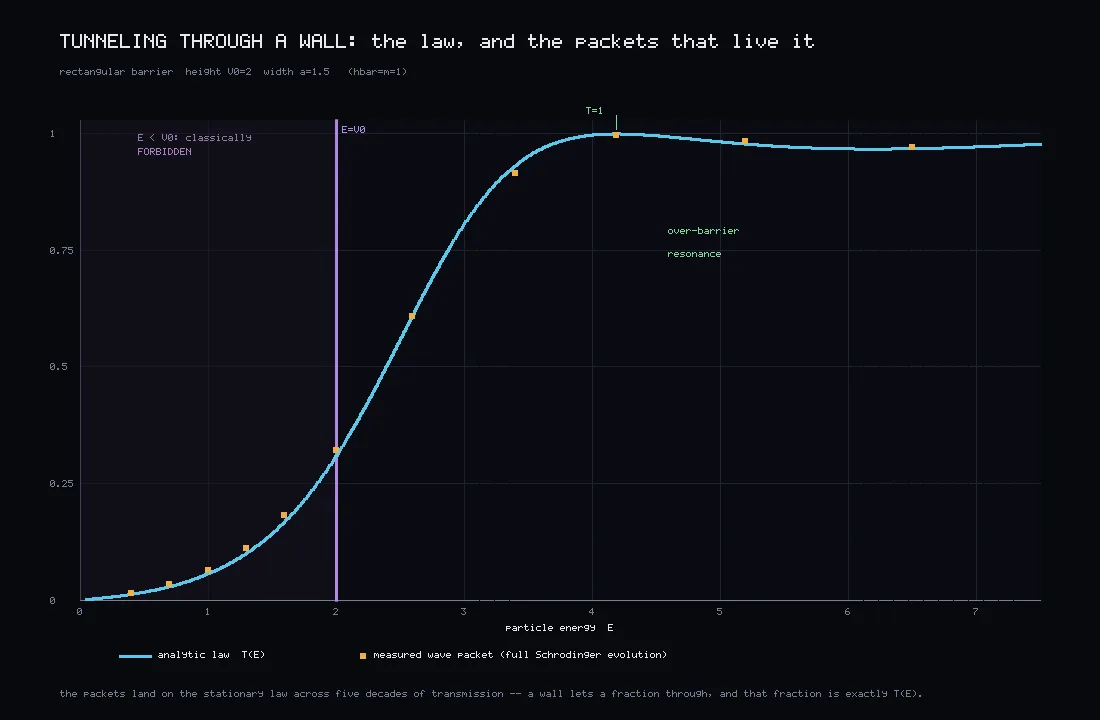
The curve is not fitted to those points. It is the closed-form transmission of a rectangular barrier, computed independently, and the points are measurements that land on it. The worst disagreement across the whole sweep is 0.0117, about one part in a hundred.
There is a small honest wrinkle in that gap, and it is physics rather than error. A packet is not a single energy, it is a spread of energies, and the fast end of that spread tunnels disproportionately better. So a real packet always transmits slightly more than its average energy would suggest.
One feature of the curve is worth pointing at. Near an energy of 4.19, well above the wall, transmission returns to essentially 1. That happens because the wall’s width is a half-integer number of the particle’s wavelength, so the reflections from the two faces cancel. A barrier can be invisible at exactly the right speed.
Two opaque walls that are transparent together
Here is the result I did not expect to be so sharp. Take a wall that passes only 8 percent. Put a second identical wall behind it with a gap between them.
Naively that is worse. Eight percent of eight percent is under one percent.
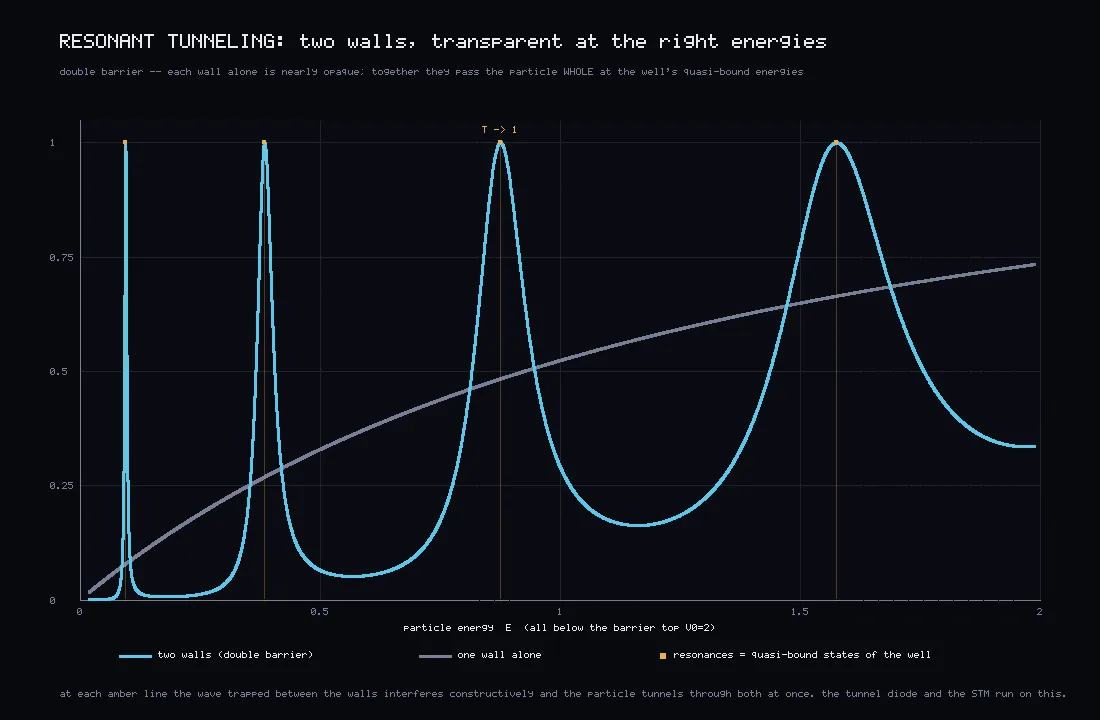
At four specific energies, all of them below the top of either wall, the pair passes essentially everything. Transmission goes to 1. The particle crosses two barriers it cannot climb as though neither were there.
The reason is that the gap between the walls is a room, and a room has notes it likes. At those energies the wave bounces inside, builds up, and leaves through the far side in step with itself. Each individual reflection is still mostly blocked. The sum of all of them is not.
The tunnel diode runs on this. So does the resonant-tunneling transistor.
Then the part measuring it taught me, which no amount of reading would have. The two lowest spikes are absurdly narrow, a few thousandths of an energy unit wide. A real packet is wider than that in energy, so it only overlaps a sliver of the spike and barely benefits. The spikes get broader as the energy rises, so the useful one is the third.
I measured that with full simulations rather than asserting it. A packet tuned to the broad resonance at 0.876 puts 72 percent of itself through both walls. The same two walls, with the packet’s energy nudged up by 0.29, pass 15 percent.
Same barriers. Same particle. One number moved slightly, and the door went from open to shut.
The one thing that broke
The matrix engine threw a singular-matrix error at one specific energy, exactly equal to the height of a barrier.
That is not a flaw in the method. At precisely that energy the wave inside the barrier has zero wavenumber, the two basis solutions the method uses stop being distinguishable, and the boundary matrix genuinely has no inverse. It is a single point of measure zero, and my energy grid happened to land on it.
I read it as my own grid hitting the one place the method is not defined, and guarded it to the correct limiting value instead of dividing by zero. The alternative reflex, deciding the transfer-matrix method is unreliable, would have been wrong and would have cost me the double-barrier result entirely.
What I re-ran before writing this
All three gates, two months later. Probability conserved to 2 parts in a trillion. The free packet spreading to 14 decimal places. The general engine against the closed form to 9 parts in a quadrillion.
Then the physics. 6.31 percent through a wall twice as tall as the particle’s energy. Eleven packets landing on the analytic curve with a worst gap of 0.0117. Four resonances below the barrier top, the lowest one passing 99.75 percent where a single wall passes 7.88 percent.
The on-resonance and off-resonance packet measurements came back at 72 percent and 15 percent. My own write-up from that night quoted 76 and 19, which came from the film’s slightly different packet rather than from this measurement. The numbers above are the ones the measurement script prints.
Looking at the plates turned up a quieter problem. That folder’s font had no percent sign and no less-than sign, and a character the font lacks is drawn as a blank. So the caption on the film that read “through the wall: 6.3%” had been rendering as “through the wall: 6.3”, and the note marking the forbidden region, “E < V0”, had lost the symbol that makes it a comparison. One line of caption also ran 88 pixels off the edge of its canvas, which the renderer discarded without a word, taking the last fourteen characters of the sentence with it.
Both are fixed at the source. The font raises now instead of drawing a blank, and it raises on a string that runs off the canvas, so the next plate that tries either one fails loudly instead of quietly.