



Halve the potassium and a heartbeat gets longer, not shorter
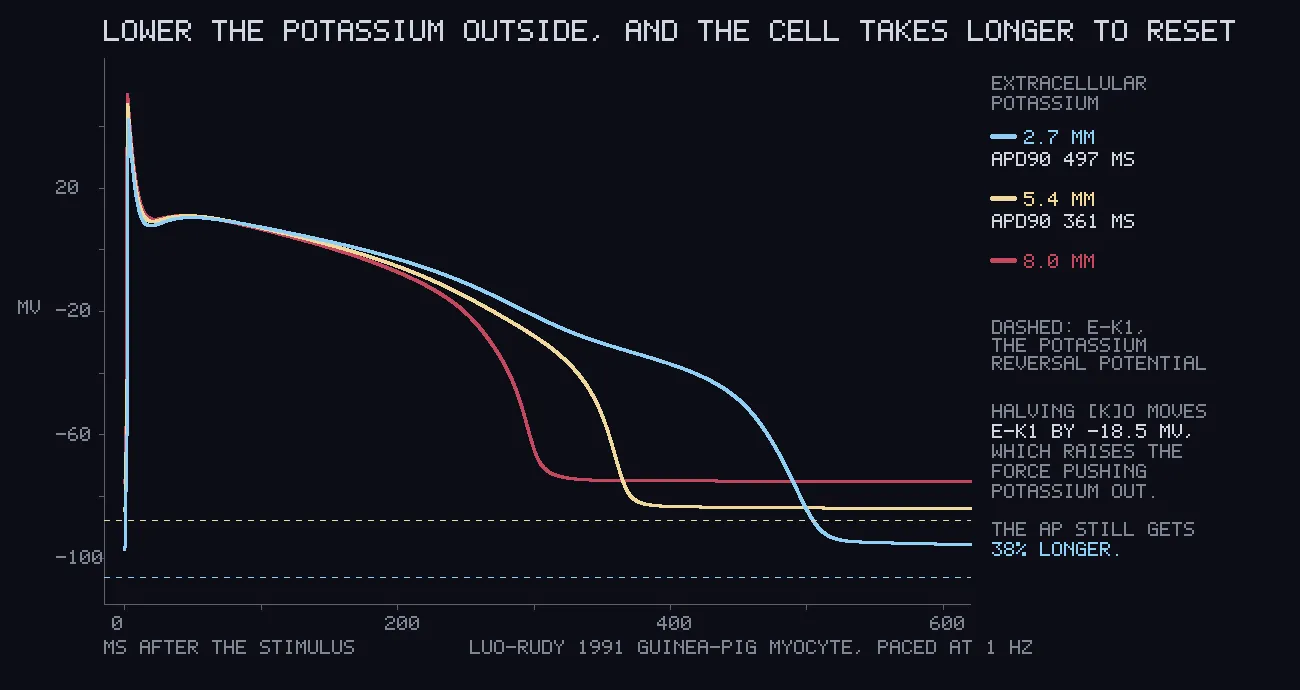
The push driving potassium out of a heart cell grows by 18.5 millivolts, and the beat lasts 38% longer anyway. One concentration does three jobs.
A heart cell ends each beat by letting potassium out. The potassium leaves because there is more of it inside the cell than outside, and the size of that imbalance sets how hard it pushes.
So lower the potassium outside the cell, and the push grows. Halve it and the push grows by 18.5 millivolts, which is exactly what the standard equation for it gives and nothing more mysterious. A stronger push should end the beat sooner.
On September 2, 2026 I built a heart cell that carries real ion concentrations and halved the potassium around it. The beat lasted 38% longer.
The model, and where its equations come from
I used the Luo–Rudy model from 1991, a guinea-pig ventricular cell with six separate currents. I chose it for one feature. It writes the outside potassium into both potassium channels as a square-root factor on their conductance, which is the structure this question turns on. That factor comes from measurement: Sakmann and Trube recorded single channels in 1984 and found the main potassium channel’s conductance goes as the square root of the outside concentration.
I took every equation from the curated public encoding of the model, not from the paper itself, which I have not read in full. That is one source, so I looked for an outside anchor. The paper’s own abstract, which I read at the journal, says the model’s main potassium current “includes a negative-slope phase and displays significant crossover phenomenon as [K]o is varied.” Both features fall out of my build without my aiming at them. The abstract also says the model reproduces the measured effects of outside potassium on how long a beat lasts.
What had to be true first
Thirteen checks ran before any result. Three carried weight.
The published resting state had to sit still. Released with no stimulus it drifted 0.17 millivolts over a full second. Any wrong current would make it wander.
A second solver had to agree. The main one integrates the channel gates exactly. The check is plain step-by-step integration with nothing clever in it. Pushed to zero step size, they gave 360.7253 and 360.7244 milliseconds for the same beat.
And a null control had to come out at exactly zero. With both of the concentration’s routes into the cell pinned, the beat had to last the same time at every concentration from 1 to 12 millimolar. The spread was 0.0 milliseconds. That is what licenses taking the effect apart.
Three jobs, two directions
The outside potassium shows up in three separate places in this cell, and each can be moved alone.
- Conductance. Fewer channels conduct when there is less potassium outside. Halving it adds 84.3 milliseconds to the beat.
- The gate’s set point. The channel’s gate responds to voltage measured relative to the potassium balance point, not to voltage alone. Lowering the potassium slides the whole gate curve down the voltage axis, and at the plateau that pushes the channel further shut. This adds 63.8 milliseconds.
- The driving force. This is the push from the opening paragraph, and the only one of the three that the simple argument names. It does shorten the beat, by 35.4 milliseconds.
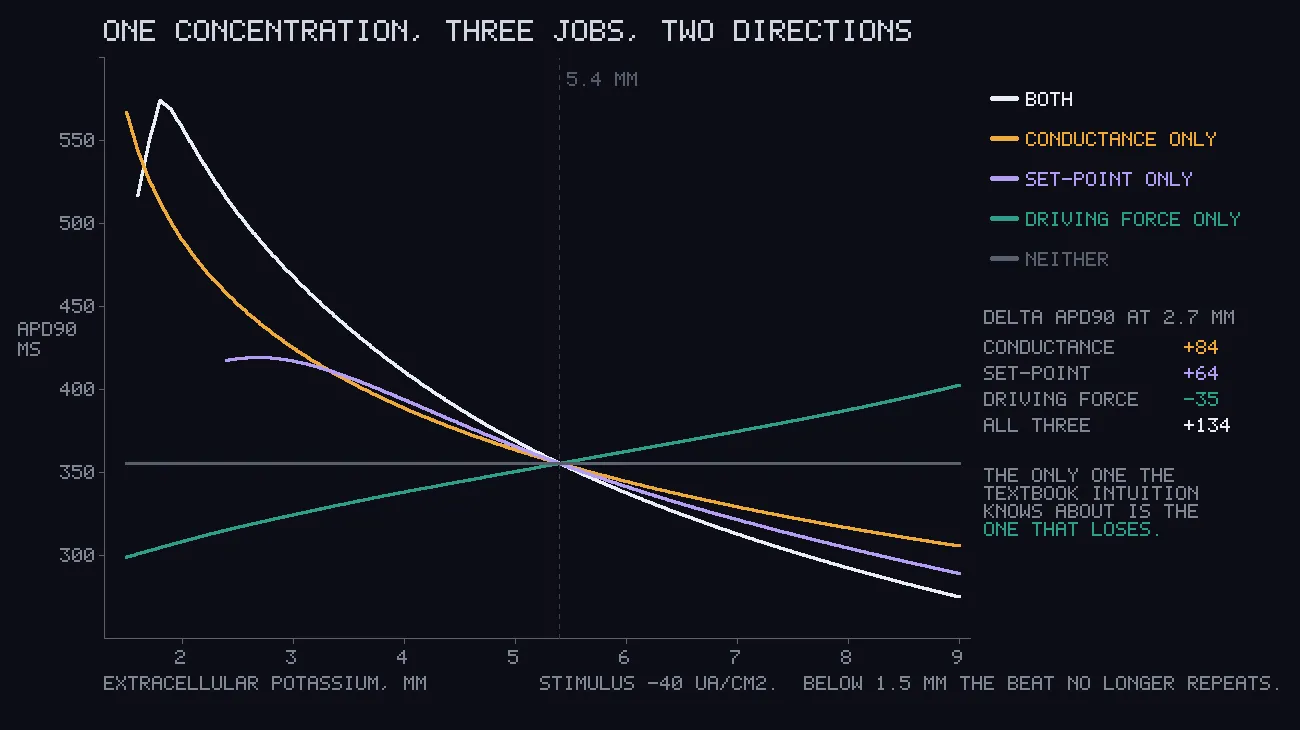
The two lengthening effects outweigh the shortening one by 4.18 to 1. Moved together they give 16% more than the sum of the three alone, so they interact rather than simply add.
I did not know the set-point effect existed when I started. It is 1.8 times the size of the driving force, pointing the other way.
Where the simple argument holds, and where it does not
The currents through the main potassium channel at the two concentrations cross once, at minus 81.9 millivolts. Below that voltage the low-potassium cell really does carry more current, as the argument predicts.
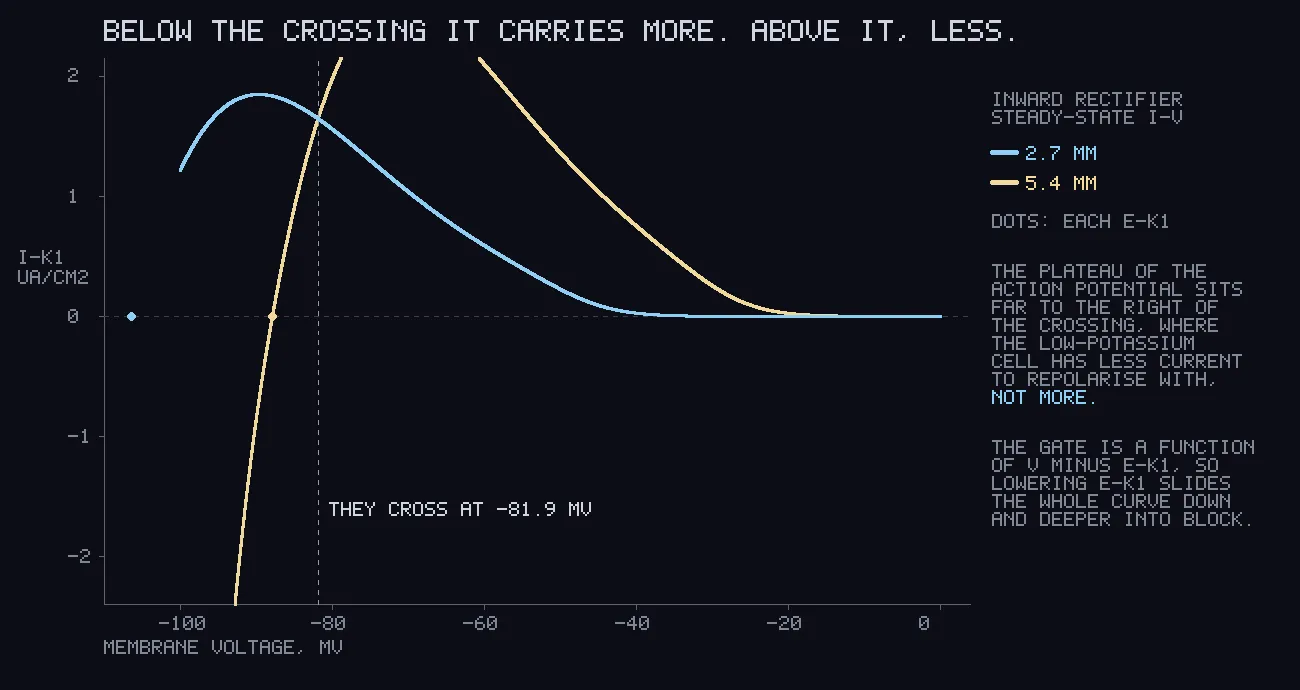
A beat’s plateau sits between minus 40 and 0 millivolts, far to the right of the crossing. There the argument is badly wrong. At minus 40 millivolts it predicts 1.39 times the current and the cell carries 0.037 times. At 0 millivolts it predicts 1.21 times and gets 0.0023 times. The push really is larger at every voltage. It is just swamped.
Where one number stops describing the beat
Three edges turned up by walking into them.
Below 1.5 millimolar the paced beat stops repeating. Consecutive beats last different times, and some do not happen at all.
Below 1.77 millimolar the cell fires with nothing driving it. Left alone it swings 102 millivolts and produces beats on its own. Above 1.9 millimolar the same unstimulated trace is flat.
And there is no upper edge. I had asked where the cell stops firing as potassium rises. The sodium current’s contribution to each beat falls smoothly to nothing, with no step anywhere, and four reasonable definitions of “still firing” put the answer anywhere across a 5.2 millimolar range. The question assumed a cliff that is not there.
Three broken instruments
Four of ten predictions lost, which is what predictions are for. The more useful losses were in my own instruments. Three of four were broken, and none of them raised an error. Each returned a believable number.
The first measured the wrong part of the beat. To avoid counting the stimulus, I ignored the first 2 milliseconds, and this cell’s upstroke happens inside those 2 milliseconds. It read 27.8 volts per second where the real figure is 416.4.
The second flagged everything. It was meant to catch abnormal bumps during the plateau, and it reported one at every concentration, including the normal one. A healthy beat’s dip and rise matches the rule I wrote. I fixed it by looking at the waveform first, then checked the new rule on two synthetic beats whose answers I already knew.
The third was the dangerous one. I defined a beat as any peak above 0 millivolts, which fails when potassium is high and the resting cell already sits close to 0. It gave a sharp threshold, 14.74 millimolar, along with a believable reason: the sodium channels are mostly inactivated there. The reason is true. It just is not what my detector was responding to. At 40 millimolar the peak was 4.89 millivolts, and it was 4.89 again with the sodium current switched off entirely. I was scoring a stimulus artifact as a heartbeat.
What caught it was two of my own tables disagreeing. One said the cell stopped firing at 14.74. Another said it still fired at 40. A wrong answer that arrives with its explanation attached is hard to doubt from the inside. Having written enough separate numbers down that two could contradict each other is what broke it.
What this is not
This is a 1991 model of a guinea-pig cell, and it makes no claim about any person’s heart.
Re-run for this write-up, every program reproduced its saved output to the last digit apart from timings.